
Want ads connect you directly with people who want to buy, sell, trade, or promote something in your area. Want ads are short classified ads that let you offer or request products and services, typically organized by category and location. You see them in newspapers, but today you mostly find them on online classifieds and marketplace platforms.

You can use classifieds to list a car, promote a service, find a job, or search for housing. Modern online marketplaces make the process faster by sorting listings into clear categories and local regions, so you can focus on what matters in your city or neighborhood. Many platforms also let you filter by price, condition, and keywords to narrow your options quickly.
As you explore how online classified ads work, you will see which platforms dominate the space, how geographic targeting shapes results, and what steps help you post or respond with confidence. You will also learn practical safety guidelines and how digital tools continue to shape the future of want ads.
How Want Ads Work in Online Marketplaces

Online want ads in digital marketplaces connect buyers and sellers through searchable listings, structured categories, and direct messaging tools. You can post, filter, and respond to classified ads within minutes using built-in search and communication features.
Key Features and Benefits
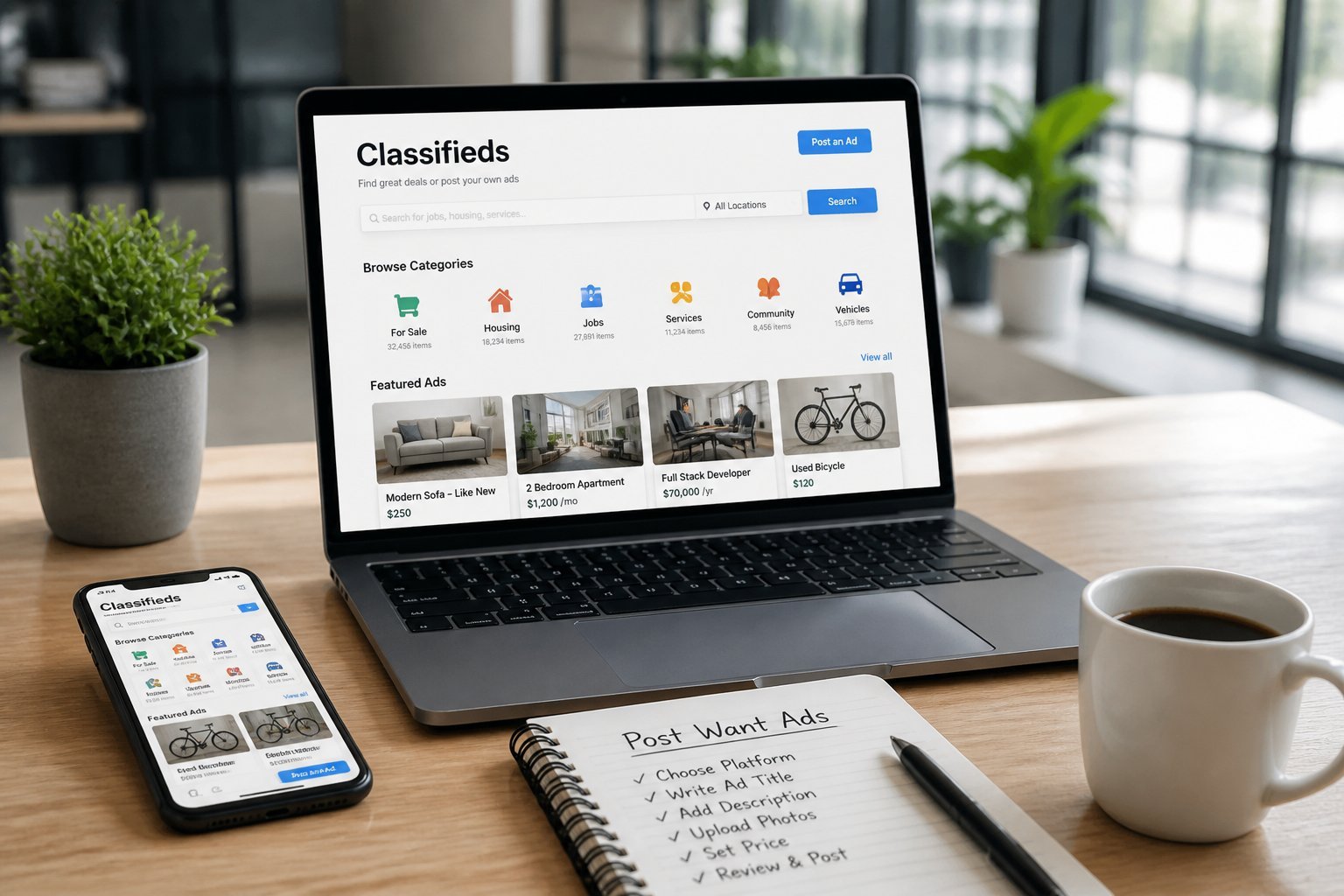
Online classifieds organize want ads into clear categories and subcategories so you can quickly narrow your focus. Most platforms provide search bars, filters, and advanced search options that let you sort by price range, location, date posted, or keyword.
You can save time by setting alerts for specific terms. When a new listing matches your criteria, the system notifies you.
Many marketplaces, including Facebook Marketplace, integrate user profiles, ratings, and messaging in one place. This setup allows you to review seller information, compare listings side by side, and contact the other party directly.
Digital want ads also support photos, pricing details, and item descriptions. These features reduce misunderstandings and help you make faster decisions than traditional print classified ads.
Common Categories of Listings
Most online classifieds group want ads into structured sections such as:
- Jobs
- Housing and rentals
- Vehicles
- Furniture and home goods
- Electronics
- Services
You can browse by category or use search tools to target specific needs. For example, if you want a used car under $10,000 within 25 miles, you can apply filters to remove unrelated listings.
On Facebook and similar platforms, categories often reflect local demand. This local focus helps you find nearby sellers and reduces shipping or travel time.
Some marketplaces also allow niche sections for collectibles, freelance work, or event tickets. Clear categorization makes large volumes of classified ads manageable and easier to compare.
Posting and Responding to Ads
To post a want ad, you typically create an account, choose a category, and complete a listing form. The form asks for a title, description, price, location, and images.
You improve visibility by writing a specific headline and including relevant keywords. Accurate pricing and detailed descriptions attract more qualified responses.
When responding to ads, you use built-in messaging systems instead of sharing personal contact details publicly. Platforms like Facebook route messages through their internal chat, which adds a layer of privacy.
You can also use advanced search tools to identify recent postings and respond quickly. Fast replies increase your chances of securing high-demand items before someone else does.
Popular Platforms for Posting Classifieds
You can publish want ads on large national marketplaces, niche classified networks, or regional platforms that target specific cities. Each option differs in cost, moderation, reach, and how quickly buyers can contact you.
Major U.S. Sites and Their Features
Craigslist remains one of the most widely used platforms for local classified ads in the U.S. You post by city, choose a category, and add contact details directly in the listing. Most categories are free, though some—such as job postings in large cities—carry a small fee.
Facebook Marketplace connects your ad to local users through your Facebook profile. You benefit from built-in messaging, user profiles, and community visibility. Facebook also integrates buy/sell groups, which can increase local exposure.
Other options include ClassifiedAds.com, which offers free listings across general categories, and Oodle, which aggregates listings and distributes them across partner sites. Traditional print-style platforms such as The Want Ad Digest and digital versions like WantAds.online and WantAdDigest.com focus on regional buyers who prefer straightforward listings without social features.
International and Regional Alternatives
If you target buyers outside the U.S., you need platforms with strong local presence. Locanto operates in multiple countries and supports city-level targeting, which helps you reach specific metro areas.
In Canada, Kijiji competes directly with Craigslist and attracts strong regional traffic. Many cities rely on it for housing, vehicles, and job listings.
You should also consider country-specific marketplace sites that mirror the structure of traditional want ads. These platforms often provide:
- Local language support
- City-based filtering
- Mobile-friendly posting tools
- Optional paid upgrades for visibility
Regional print publications that now operate online, such as localized want ads portals, still attract consistent traffic from readers who prefer classified-style browsing over social feeds.
Comparing Platform Advantages
You choose a platform based on reach, cost, and control over communication. Large marketplaces like Facebook Marketplace provide identity transparency and built-in messaging, which can reduce spam but require an active profile.
Sites like Craigslist and ClassifiedAds.com offer more anonymity and simple listing forms. They work well if you want quick posting without linking personal accounts.
Consider these factors before posting:
| Platform | Best For | Key Advantage | Potential Limitation |
|---|---|---|---|
| Craigslist | Local sales, rentals | Strong city-based traffic | Limited profile verification |
| Facebook Marketplace | Consumer goods | Integrated messaging and profiles | Requires Facebook account |
| Locanto | International reach | Multi-country access | Traffic varies by region |
| Oodle | Broad exposure | Aggregated distribution | Less direct brand control |
If you post regularly, test two or three platforms and track response rates. Your results will depend on category demand, pricing accuracy, and how clearly you structure your classified ads.
Geographic Coverage and Localized Classifieds
Want ads operate at both state and city levels, letting you target buyers, renters, or job seekers with precision. Coverage spans all 50 U.S. states and extends into major international markets, with many platforms offering free local listings across hundreds of metro areas.
United States State-by-State Overview
You can publish or browse want ads in every U.S. state, from Alabama, Alaska, and Arizona to Wisconsin and Wyoming. Most major platforms organize listings by state first, then by metro area or county, which helps you narrow results quickly.
Large states such as California, Texas, Florida, and New York generate high listing volumes in jobs, housing, and vehicles. Midwestern states like Illinois, Indiana, Iowa, Kansas, Michigan, Minnesota, Missouri, Nebraska, North Dakota, Ohio, South Dakota, and Wisconsin often show strong activity in equipment, farm vehicles, and local services.
In the South, states including Georgia, North Carolina, South Carolina, Tennessee, Kentucky, Mississippi, Louisiana, Arkansas, Virginia, and West Virginia support active community-based trading. Western states such as Colorado, Utah, Nevada, Idaho, Montana, Oregon, Washington, New Mexico, and Wyoming often emphasize outdoor gear, rentals, and regional services.
Smaller states—Connecticut, Delaware, Maine, Maryland, Massachusetts, New Hampshire, New Jersey, Rhode Island, and Vermont—typically cluster listings around dense population centers. You also find localized ads in the District of Columbia (Columbia) with strong demand for housing and professional services.
Major U.S. Cities for Local Listings
If you want higher visibility, focus on large metro areas. Cities such as New York City, Los Angeles, Chicago, Houston, Phoenix, Philadelphia, San Antonio, San Diego, Dallas, San Jose, Austin, Jacksonville, Fort Worth, Columbus, Charlotte, San Francisco, Indianapolis, Seattle, Denver, Boston, Detroit, Minneapolis, Portland, and Sacramento attract heavy daily traffic.
These cities support fast-moving categories like apartment rentals, used cars, and job postings. In Atlanta, Raleigh, Greensboro, Asheville, Wilmington, Charleston, Savannah, Augusta, Athens, Myrtle Beach, Greenville, and Hilton Head, you often see strong demand for seasonal work, tourism services, and short-term rentals.
College towns such as Blacksburg, Knoxville, Fayetteville, Lynchburg, Hickory, Florence, Roanoke, and the Tri-Cities region generate steady listings for shared housing and textbooks. In the Pacific Northwest, Seattle and Vancouver show active tech job listings and urban rentals.
You benefit from city filters that sort by neighborhood or ZIP code, which supports precise geographic advertising.
International Coverage and Expansion
Many classified platforms extend beyond the United States into Canada, Mexico, Panama, India, and parts of Europe and Australia. You can often switch countries from a dropdown menu and view listings organized by province, state, or metro region.
In Mexico and Panama, listings frequently focus on real estate, vehicles, and local services for both residents and expatriates. In India, major cities drive high volumes in jobs, electronics, and rental housing.
International expansion relies on localized categories, currency settings, and language options. When you post across borders, you must adjust pricing, contact details, and delivery terms to match local regulations and buyer expectations.
Tips for Effective Search and Advanced Filtering
You get better results from want ads when you control how you search and filter listings. Clear keywords, targeted filters, and careful review of results help you find relevant classified ads faster and avoid low-quality posts.
How to Find the Right Listings
Start with precise keywords that match the exact item, service, or role you want. Instead of searching “apartment,” search “2-bedroom apartment downtown Chicago” or “remote bookkeeping part-time.” Specific phrases reduce irrelevant classifieds and surface listings that fit your criteria.
Use quotation marks for exact phrases when the platform supports it. This narrows search results to listings that include that exact wording, which helps when you look for a specific job title or product model.
Refine by category before you browse. Most classified ads platforms divide listings into sections such as housing, jobs, services, or for sale. Selecting the correct category first removes unrelated posts and improves relevance.
Scan titles and preview text carefully. Many sellers and employers place key details—price, location, condition—directly in the headline. This lets you dismiss mismatched listings quickly without opening each one.
Using Advanced Search Tools
Advanced search features help you narrow results with precision. Look for filters such as:
- Price range
- Location or radius
- Date posted
- Condition (new/used)
- Job type (full-time, contract, remote)
Apply multiple filters at once to reduce clutter. For example, combine a price cap with a specific location radius and a recent posting date to see only relevant classified ads.
Use search operators if the platform or search engine allows them. Quotation marks can lock in exact phrases, while operators like site: in external search engines restrict results to a specific classifieds website.
Sort results strategically. Sorting by “newest” helps in competitive markets, while sorting by “lowest price” or “highest pay” supports budget or income goals. Adjust filters as you review results rather than starting over each time.
Avoiding Common Pitfalls
Avoid overly broad searches. A single-word search often returns hundreds of unrelated classifieds, which wastes time and increases the risk of missing strong listings buried in the results.
Do not ignore posting dates. Old want ads may no longer be active, especially in fast-moving categories like jobs or rentals. Filtering by recent posts keeps your search current.
Be cautious with incomplete listings. Classified ads that lack photos, detailed descriptions, or clear contact information often signal low effort or potential scams. Prioritize posts with specific facts and transparent details.
Finally, avoid relying on one search method. Combine keyword refinement, category browsing, and advanced search filters to maintain control over the quality and relevance of your results.
Safety and Best Practices for Buyers and Sellers
You reduce risk when you limit the information you share, verify who you are dealing with, and use secure payment and meeting methods. Clear communication and simple precautions prevent most problems on want ad and online marketplace platforms.
Protecting Personal Information
Share only the details required to complete the transaction. Do not post your home address, personal email, or primary phone number in a public listing.
Use the platform’s internal messaging system whenever possible. Many classified and marketplace sites mask your contact details and reduce direct exposure.
Avoid sending copies of your ID, bank statements, or verification codes. A common scam involves someone asking for a Google Voice or similar verification code; if you share it, they can link your number to their account and misuse it.
Create a separate email address for buying and selling.
Use strong, unique passwords and enable two-factor authentication if the platform offers it.
When meeting locally, avoid inviting strangers into your home. Choose a public location and keep personal documents and valuables out of sight.
Recognizing and Avoiding Scams
Watch for overpayment schemes. A buyer may send a check for more than the agreed price and ask you to refund the difference. Banks can make funds appear available before they confirm the check is legitimate, leaving you responsible when it bounces.
Be cautious with mobile payment apps. Scammers may send fake payment confirmations or claim they paid twice and request a refund.
Common red flags include:
- Pressure to act immediately
- Refusal to meet in person for local sales
- Requests to move the conversation off the platform quickly
- Poorly written messages that avoid specific details about the item
Do not accept payments from people you do not know unless the platform offers clear seller protections. Report suspicious behavior to the site and to the Federal Trade Commission at ReportFraud.ftc.gov if you suspect fraud.
Guidelines for Successful Transactions
Set clear terms in your listing. State the price, accepted payment methods, item condition, and whether the price is firm.
For local transactions, meet in well-lit public areas such as police station parking lots or busy retail centers. Bring a friend when possible and keep meetings brief and focused on the exchange.
Cash remains the simplest option for in-person sales. For online payments, use methods with documented buyer and seller protections, and confirm funds within the platform before shipping.
Inspect items carefully before paying. Test electronics, review serial numbers when relevant, and ask direct questions about defects or prior damage.
Keep records of messages, receipts, and tracking numbers. Documentation helps resolve disputes and supports any formal complaint you may need to file.
Future Trends in Online Classified Advertising
Online classified ads now rely on mobile access, AI-driven personalization, and cross-border visibility to stay competitive. You will see faster search, more relevant listings, and broader market access as platforms refine how classifieds connect buyers and sellers.
Mobile and App-Based Listings
You already see most classified ads on your phone, and that shift will continue. Increased smartphone penetration and mobile internet access drive steady growth in app-based classifieds across job boards, real estate, and local marketplaces.
Mobile apps now prioritize speed and simplicity. You can post listings in minutes, upload photos directly from your device, and manage responses through in-app messaging.
Platforms also optimize location-based search so you can find nearby listings without entering detailed filters. Push notifications alert you when new ads match your saved searches.
Many apps now include:
- One-tap reposting
- In-app payments or booking tools
- Real-time chat with buyers or sellers
- Saved and advanced search filters
If you run listings, mobile dashboards let you track views, clicks, and response rates. This data helps you adjust pricing or refresh ads quickly to stay competitive.
AI and Smarter Search Solutions
Artificial intelligence now shapes how you experience search results in online classifieds. Platforms use behavioral data and past interactions to personalize the listings you see.
When you perform a search, algorithms rank ads based on relevance, location, pricing trends, and your browsing history. This approach improves matching accuracy and reduces time spent scrolling through irrelevant posts.
You also benefit from smarter tools such as:
- Predictive text in search bars
- Automated category suggestions during ad posting
- Dynamic pricing insights
- Spam and fraud detection systems
Advanced search features now include filters for condition, distance radius, posting date, and seller rating. AI systems also flag duplicate listings and suspicious activity, which helps maintain trust within classified ad platforms.
As AI models improve, expect more accurate recommendations and stronger content moderation without increasing complexity for you.
Expanding Global Reach
Online classified advertising no longer limits you to local newspapers or single cities. Digital platforms allow you to reach regional, national, and international audiences with minimal added effort.
Growing digital commerce adoption continues to shift classified ads from print to online formats. This transition expands revenue models through listing fees, featured placements, and premium visibility options.
If you sell products, you can now:
- Target specific countries or regions
- Translate listings automatically
- Display prices in local currencies
- Accept cross-border payment methods
Global reach also increases competition. You must write clearer descriptions, use precise keywords for search visibility, and rely on advanced search filters to stand out.
As internet access expands in emerging markets, you gain access to new buyers and service providers. Online classifieds will continue evolving into broader digital marketplaces that connect users across geographic boundaries.
