
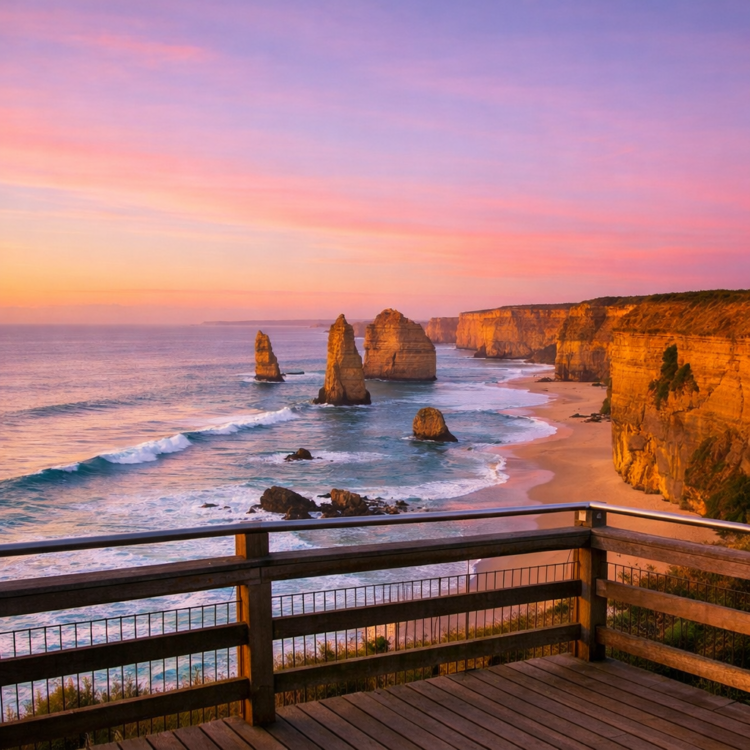
If you’re planning a sunrise at the Twelve Apostles along Victoria’s Great Ocean Road, you’re about to witness one of Australia’s most photographed landmarks in its finest light—and with barely another soul around. Most visitors roll up mid-morning or early afternoon to find packed car parks and hundreds of people jostling for space at the viewing platforms. Dawn is different.
Why Sunrise at the Twelve Apostles Beats Any Other Time
The light at dawn does something extraordinary to these limestone stacks. As the sun lifts out of the ocean behind you, it paints the rock faces in shades of orange, pink and gold that simply don’t exist at midday. The cliffs glow. The Southern Ocean turns from slate-grey to deep blue, and if you’re lucky, mist hovers just above the water.
Then there’s the solitude. Arrive thirty minutes before sunrise and you might share the viewing platform with a handful of photographers and maybe one or two other early risers. By 10 a.m., that same spot will host tour buses, families, and couples wielding selfie sticks. The difference is stark.
Practical Tips for Catching Sunrise on the Great Ocean Road
You’ll need to stay nearby the night before—Twelve Apostles sunrise means a very early start if you’re driving from Melbourne (it’s about three hours each way). Port Campbell, about ten minutes west, is the closest town with accommodation options. Check local visitor information websites for current availability and booking details, especially during summer (December to February) and school holidays.
The viewing platforms are accessible 24 hours, and there’s no entrance fee. Car parks are well-lit, though they’re designed for daylight use, so bring a torch if you’re walking from your car in the dark. The main viewing platform is paved and wheelchair accessible, with clear safety barriers.
What to Bring
- Warm layers—coastal mornings are cold year-round, especially in winter (June to August) when temperatures can drop to single digits
- A headlamp or torch for the walk from the car park
- Camera gear if you’re into photography (a tripod is ideal for low-light shots)
- Hot coffee in a thermos—there are no cafes open at 6 a.m.
- Patience for the light to develop (arrive 30-45 minutes before official sunrise time)
What the Early Morning Light Reveals
Sunrise doesn’t just illuminate the famous stacks themselves. Look west along the coastline and you’ll see the full sweep of cliffs stretching toward the Shipwreck Coast, dramatic and empty. Seabirds wheel and call above the rock platforms. Sometimes you’ll spot seals on the rocks below, though binoculars help.
The Twelve Apostles themselves—actually eight remaining stacks, despite the name—change minute by minute as the sun climbs. What starts as silhouette becomes texture: you can see the layered sedimentary bands, the caves carved by millennia of wave action, the vegetation clinging to the tops. It’s geology and light working together.
After the Show: Where to Go Next
Once the sun is fully up and the tour buses start arriving (usually around 9-9:30 a.m.), you’ve already had the best of it. Head west to Loch Ard Gorge, just a few minutes’ drive, where the morning light is equally beautiful and the historic shipwreck site adds another layer to the story.
Gibson Steps, east of the main viewing area, offers beach-level access to the rock stacks at low tide—though you’ll need to check tide times and access details at the visitor information centre, as the beach can be cut off when the tide is high. By mid-morning you’ll have worked up an appetite; Port Campbell’s cafes will be open for a proper breakfast.
Timing Your Visit Throughout the Year
Dawn at the Twelve Apostles works year-round, but each season brings something different. Summer sunrise (December to February) means an earlier alarm—around 5:30 a.m. for a 6 a.m. sunrise—but warmer temperatures and calmer seas. Winter sunrise comes later, closer to 7-7:30 a.m., making it easier to manage, though you’ll need serious layers against the wind.
Autumn (March to May) offers the sweet spot: reasonable sunrise times, fewer crowds even later in the day, and often spectacular weather. Spring (September to November) can be windy, but the light is crisp and clear. Check the Bureau of Meteorology forecast before you commit to the drive—low cloud or rain will obscure the sunrise entirely, and there’s no point arriving in the dark if you can’t see anything.
The Real Reason to Wake Up Early
Strip away the photography talk and the crowd-avoidance strategy, and here’s what matters: sunrise at the Twelve Apostles gives you a few quiet minutes with one of Australia’s great natural landmarks before the world wakes up. The sound of waves on rock, uninterrupted. The cold air, the changing light, the sense that you’re witnessing something daily but never quite the same twice.
It requires effort—setting an alarm when you’re on holiday isn’t fun—but every visitor I’ve spoken to who made the effort has said the same thing. They’d do it again tomorrow.
You might also like:
- Making the Most of Koala Encounters at Billabong Zoo Port Macquarie
- Canoeing the Namoi River Gorge: A Warrabah National Park Adventure
For current opening hours, prices and bookings, see Parks Australia – Uluru-Kata Tjuta National Park.
