
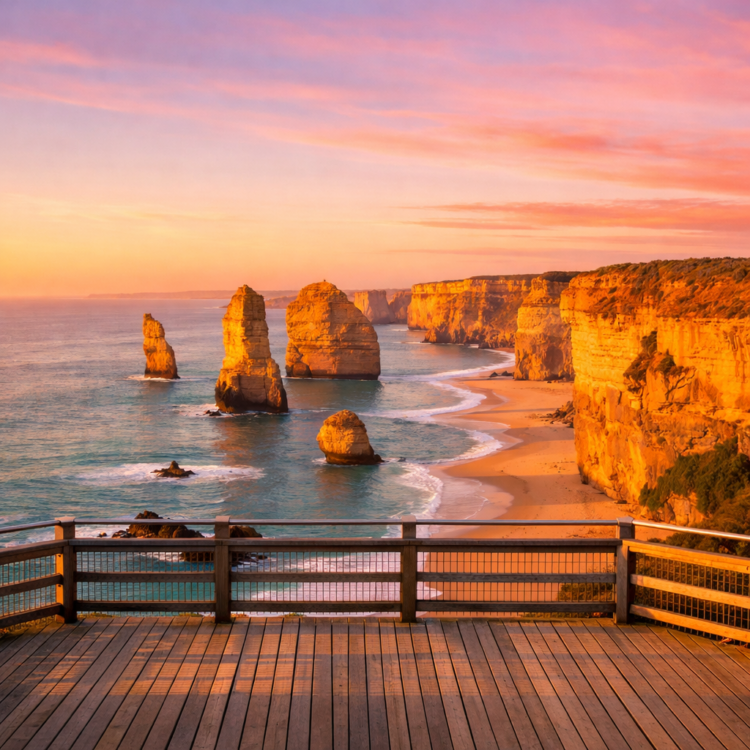
The best time to drive the Great Ocean Road isn’t when most people think. Most visitors arrive at the Twelve Apostles mid-afternoon, jostling for space at the viewing platforms alongside tour buses and selfie sticks. But if you time your drive to catch sunrise at these iconic limestone stacks, you’ll witness something entirely different—and have the coastline nearly to yourself.
Why Sunrise Beats Midday at the Twelve Apostles
The light at first dawn transforms the limestone completely. Instead of the harsh overhead sun that flattens the rock faces into pale monotones, the low morning rays paint the apostles in shades of amber, rose, and burnt orange. The shadows are long and dramatic. The ocean catches the colour.
More importantly, you’ll share the viewing platforms with maybe a handful of photographers instead of hundreds of day-trippers. The silence alone is worth the early alarm. You can hear the waves hitting the base of the stacks, the seabirds calling, the wind moving through the coastal scrub. It’s the difference between experiencing a natural landmark and queuing for a photo opportunity.
Planning Your Great Ocean Road Drive for Dawn
To catch sunrise at the Twelve Apostles, you’ll need to stay overnight somewhere close. The coastal town of Port Campbell is the nearest base, about fifteen minutes east of the apostles viewing area. Apollo Bay, about an hour’s drive northeast, offers more accommodation options and makes a good stopover if you’re coming from Melbourne.
The drive from Melbourne takes roughly three hours without stops—and you’ll want stops—so attempting a dawn arrival as a day trip means leaving the city around 2 or 3 AM. Not impossible, but you’ll be exhausted before you’ve even started enjoying the coast.
Check the sunrise time for the date you’re visiting (it varies significantly between summer and winter, given Victoria’s southern latitude) and give yourself at least thirty minutes of driving buffer. The viewing area car park is open 24 hours, and there’s proper lighting on the boardwalk path to the platforms.
What to Expect When You Arrive Early
The temperature at the coast before sunrise can shock you, even in summer. The Southern Ocean doesn’t warm up much, and the wind off the water cuts through light jackets. Bring layers—a windproof outer shell over a fleece or jumper works well year-round. In winter (June through August), you’ll want a proper winter coat, gloves, and a beanie.
The main viewing platform sits about a five-minute walk from the car park along a sealed, accessible path. There are two main lookout points, both offering different angles on the stacks. If you arrive in full darkness, bring a small torch or use your phone light for the walk, though the path lighting is generally adequate.
Essential Items for a Sunrise Visit
- Warm, windproof jacket and layers
- Camera with fresh battery (cold drains them faster)
- Tripod if you’re keen on photos (the light is low)
- Thermos of coffee or tea
- Head torch or phone for pre-dawn navigation
The Best Time of Year to Drive This Route
Autumn (March through May) offers the most reliable weather for an early Great Ocean Road journey. You get clear mornings more consistently than in winter, when fog and rain often roll in overnight. Spring (September through November) runs a close second, though the dawn temperature is noticeably colder.
Summer brings earlier sunrises—sometimes as early as 6 AM—which means less painful wake-up times. But summer also means more people, even early in the morning. December and January school holidays see Australian families on road trips, and you’ll find the car park busier even at dawn.
Winter sunrise doesn’t happen until after 7 AM, making the logistics easier, but you’re gambling on weather. Stormy conditions can be spectacular for photography but less pleasant for standing on an exposed clifftop in the wind.
After Sunrise: Making the Most of Your Early Start
Once you’ve watched the sun climb and the light shift, you’re already ahead of 95% of visitors who are still eating breakfast two hours away. Head west along the coast to Loch Ard Gorge, just five minutes further, where the morning light hits the sheltered beach between the cliffs. The gorge is named after a historic shipwreck, and interpretive signs tell the dramatic story of the wreck’s survivors.
By mid-morning, as the tour buses begin arriving at the Twelve Apostles, you can be exploring quieter sections of the coast or heading inland. Port Campbell itself has good cafés for a proper breakfast, and you can check current opening hours at the Port Campbell Visitor Centre.
Practical Notes for Your Journey
Traffic drives on the left in Australia, which catches some international visitors off guard on winding coastal roads in low light. Take your time. The Great Ocean Road has plenty of scenic lookout points where you can pull over safely if you need to adjust to the conditions or let faster traffic pass.
Mobile phone coverage is patchy along this stretch of Victoria’s coast, so download any maps or directions before you leave your accommodation. Petrol stations are limited—fill up in Apollo Bay or Port Campbell rather than gambling on finding an open servo at dawn.
For current road conditions, park access details, and any temporary closures (coastal erosion occasionally affects viewing platforms), check with the official Great Ocean Road visitor information services before you set out. The effort of an early alarm clock and a pre-dawn drive pays itself back the moment you see those ancient limestone pillars catching the first rays of sun with nobody else around to break the spell.
You might also like:
- Driving to Port Macquarie from Sydney: Your Complete Road Trip Guide
- A Weekend Hiking Mount Kaputar from Moree: Your First-Timer’s Itinerary
For current opening hours, prices and bookings, see Parks Australia – Uluru-Kata Tjuta National Park.
