
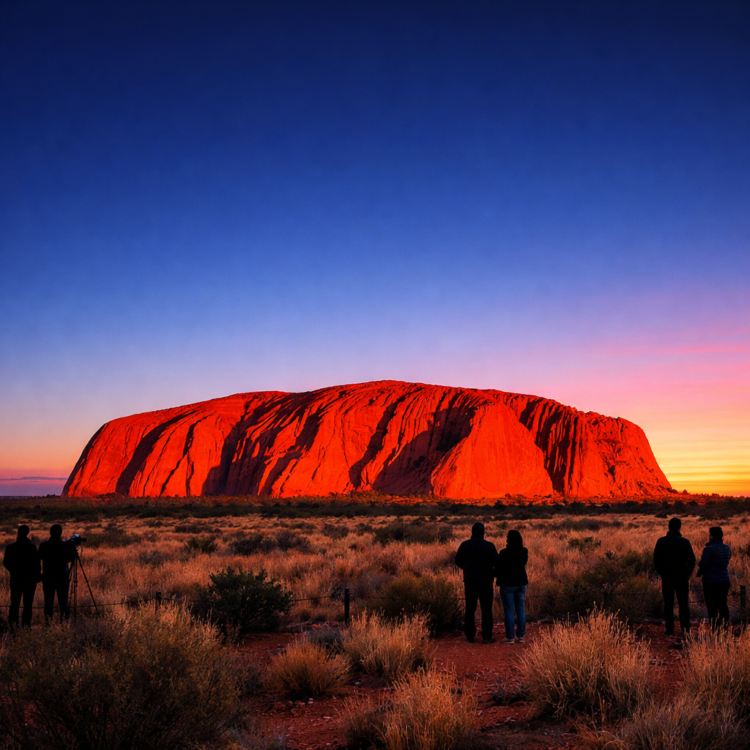
Watching sunrise at Uluru is one of those travel experiences that lives up to every expectation you bring to it. As the sky lightens over the Red Centre, the massive sandstone monolith—rising 348m above the surrounding plain—shifts through deep purples and charcoal greys, then ignites into rust-orange and finally glows a fierce terracotta red as the sun climbs higher. It’s not just beautiful. It’s disorienting, humbling, and worth the pre-dawn wake-up call.
Why Sunrise Beats Sunset at Uluru
Both sunrise and sunset draw crowds to Uluru-Kata Tjuta National Park, but dawn has distinct advantages. The light hits the western face of the Rock at sunrise, illuminating the most photographed side while you watch from designated viewing areas to the west. The air is cooler—crucial if you’re visiting between October and March when daytime temperatures can be punishing. And honestly? There’s something about being out there in the quiet before the day really begins, when the only sounds are the desert wind and the occasional birdcall.
Sunset viewing areas face Uluru from the opposite direction, which means you’re watching the Rock catch the last light rather than the direct glow. Still spectacular, but the colour transformation isn’t quite as dramatic.
Planning Your Dawn Visit to the Rock
The Talinguru Nyakunytjaku sunrise viewing area is the park’s official spot for catching dawn at Uluru. It’s an elevated platform with unobstructed views and interpretive information about the Anangu people, the traditional owners who have lived here for more than 30,000 years. You’ll need to arrive early—most visitors show up 30 to 45 minutes before sunrise to claim a good vantage point and watch the full colour progression.
Sunrise times shift throughout the year, obviously. In December and January (summer), you’re looking at a sunrise around 6:00 AM, while in June and July (winter) it’s closer to 7:30 AM. Check the exact time for your visit dates and work backwards from there. The drive from Ayers Rock Resort takes about 20 minutes.
What to Bring for Sunrise at Uluru
- Warm layers—even in summer, pre-dawn temperatures in the desert can surprise you
- A headlamp or torch with a red-light setting (less disruptive to others’ night vision)
- Coffee or tea in a thermos (there are no facilities at the viewing area)
- Your camera, ideally with a tripod for low-light shots
- Water for after the sun comes up
Understanding the Colour Changes
The colour shifts you see at dawn aren’t a trick of the light—they’re geology in action. Uluru is made of arkose, a coarse-grained sandstone rich in feldspar. The Rock’s famous red hue comes from oxidized iron in the stone, essentially rust on a monumental scale. As the angle and intensity of sunlight changes, different mineral surfaces reflect different wavelengths. The result is that progression from grey to purple to burning orange that makes sunrise viewing so compelling.
The base circumference of Uluru stretches about 9.4km, and much of the Rock’s mass is actually below ground. What you’re seeing at sunrise is just the tip of an enormous geological formation that extends far beneath the red sand.
After the Sun Rises: The Base Walk
Once the colour show winds down and the sun clears the horizon, you have perfect conditions for the base walk around Uluru. The morning light is softer, temperatures are still manageable, and you can explore rock art sites, waterholes, and caves around the circumference. The full loop takes most people three to four hours at a relaxed pace.
Climbing Uluru was permanently closed in 2019 out of respect for Anangu cultural beliefs. The Rock is a sacred site, and the traditional owners have always asked visitors not to climb. The base walk offers a far more meaningful way to experience the monolith anyway—you get close enough to appreciate the texture of the stone, the desert vegetation, and the quiet presence of the place.
Practical Details for Visiting at Dawn
You’ll need a park pass to enter Uluru-Kata Tjuta National Park, valid for three consecutive days. Purchase it at the entry station on your way in or book ahead online. For current pass prices and park opening times, check the official Parks Australia website before your trip.
The nearest accommodation is Ayers Rock Resort, about 30km from Uluru (roughly 30 minutes by road). Alice Springs, about 4.5 hours north by car, is the other option if you’re doing a longer Red Centre road trip. Most visitors fly into Ayers Rock Airport and base themselves at the resort for a few days to see both Uluru and nearby Kata Tjuta, where the tallest dome rises about 546m.
Winter (June through August) brings the most comfortable temperatures for sunrise viewing, with cool mornings and mild days. Summer months are scorching by mid-morning, but the earlier sunrise times mean you can still catch dawn without suffering through the heat. Just bring plenty of water and sun protection for anything you do after sunrise.
Why It’s Worth the Early Start
Getting up well before dawn on holiday isn’t everyone’s idea of fun. But watching the sun rise over Uluru isn’t a box-ticking exercise—it’s the moment the scale and presence of the Rock actually sink in. The changing light reveals textures and contours you won’t notice in flat midday sun. The silence and space of the desert at dawn puts you in a different headspace entirely.
Uluru-Kata Tjuta National Park was first declared a national park in 1950 and became a dual-listed UNESCO World Heritage Site in 1987 for both its natural and cultural significance. Standing there at sunrise, watching light move across stone that’s been sacred to the Anangu for more than 30,000 years, you understand why. It’s not just a photo opportunity. It’s a perspective shift.
You might also like:
- How to Write a Pet Adoption Listing That Gets Noticed
- How to Price Garage Sale Items: A Room-by-Room Guide to Fair Pricing
For current opening hours, prices and bookings, see Australia.com (Tourism Australia) – Uluru & Kata Tjuta.
