
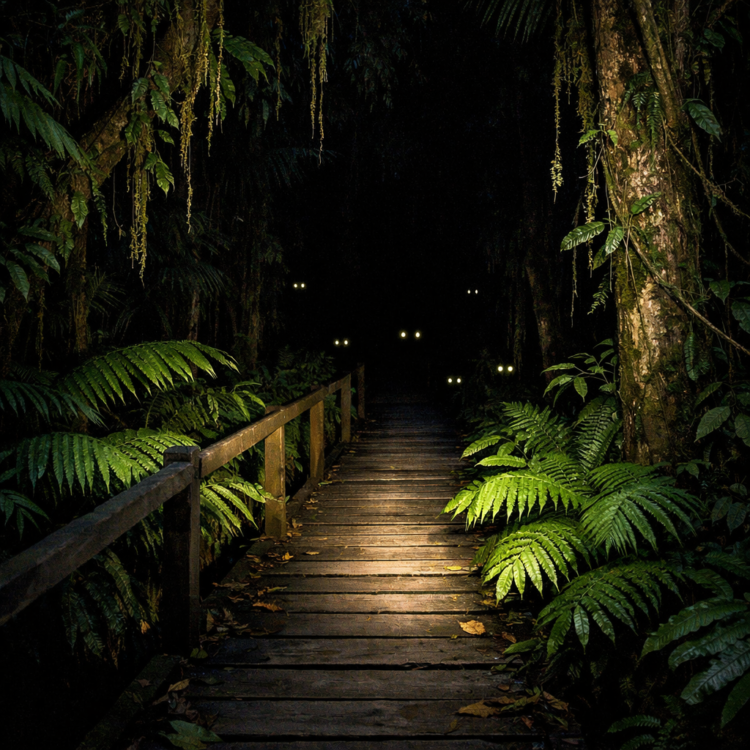
A Daintree rainforest night walk reveals an entirely different world from the daytime jungle trails. When the sun drops below the canopy of this 135-million-year-old ecosystem in far north Queensland, the forest floor comes alive with creatures you’d never spot during daylight hours. The rustle of leaves takes on new meaning. Every snap of a twig could be something extraordinary.
Why Walk the Daintree Rainforest After Dark?
Most visitors explore the Daintree between breakfast and sunset, missing the fact that roughly 60% of rainforest species are nocturnal. Tree kangaroos descend from the canopy to feed. Freshwater turtles emerge along creek edges. The luminous eyes of sleeping birds reflect back from the understory.
Boyd’s forest dragons—vivid green lizards that blend invisibly into foliage by day—become easy to spot as they sleep on exposed branches. You’ll find them motionless, completely vulnerable, their scales glowing almost neon in torchlight. Pythons drape from vines. Stick insects the length of your forearm march across the path with alien deliberation.
The Sound Transforms Everything
The cacophony is what strikes you first. Cicadas create a wall of sound so thick it feels physical. Frogs call from every direction—croaks, whistles, chirps layering over each other. Without the visual distractions of daylight, your ears do the heavy lifting. You’ll hear possums crashing through branches overhead long before your torch beam finds them.
Practical Essentials for Your Daintree Rainforest Night Walk
Independent walking after dark isn’t recommended unless you’re an experienced rainforest navigator—the Daintree’s trails aren’t lit, and the density of vegetation makes it easy to become disoriented. Guided night walks are the smart choice. Local operators know the territory intimately and can interpret the forest sounds you’re hearing.
Check with the visitor centre or your accommodation for current operator details and booking requirements. Tours typically run 1.5 to 2 hours and start just after sunset.
- Closed-toe walking shoes with grip—paths get slippery, and you’re navigating by torchlight
- Long sleeves and trousers in breathable fabric (protection from scratches and insects)
- Insect repellent (apply before you start; mosquitoes and sandflies are active)
- A small water bottle (it’s humid, even at night)
- A red-filter torch if you have one (less disruptive to wildlife, though guides usually provide adequate lighting)
What to Expect on a Night Walk in the Daintree
The pace is slow. Deliberate. You’ll spend minutes standing motionless while your guide points out a hunting spider the size of a dinner plate, or tracks a green tree frog stalking insects along a handrail.
Temperatures drop after sunset but rarely below 20°C even in winter (June-August). The air stays thick with humidity—you’ll feel it on your skin within minutes. Summer months (December-February) bring afternoon storms that taper off by evening, leaving the forest dripping and alive with movement.
Wildlife You Might Encounter
No two Daintree night walks are identical. Sightings depend on season, weather, and pure luck. Musky rat-kangaroos forage in the leaf litter. Striped possums with their skunk-like markings raid tree hollows for insects. If you’re exceptionally fortunate, a spotted-tail quoll might cross the path—a cat-sized carnivorous marsupial with white spots and a intense, focused gaze.
Cassowaries occasionally appear on night walks, though they’re less common after dark. These massive, prehistoric-looking birds are best observed from a respectful distance—your guide will know the protocols.
Best Time for a Daintree Rainforest Night Walk
The Daintree operates on a tropical calendar: the Wet (roughly November to April) and the Dry (May to October). Each season offers different nocturnal experiences.
The Dry brings clearer nights and more comfortable humidity levels, making it popular with visitors. But the Wet has its own magic—frog diversity explodes, moths crowd around any light source, and the forest smells of wet earth and decomposition, that rich petrichor unique to ancient rainforests.
Whichever season you choose, book your night walk experience early in your Daintree visit. If the conditions are perfect and the wildlife cooperates, you might want to go again.
Getting to the Daintree for Your After-Dark Adventure
The Daintree is in far north Queensland, north of Cairns and Port Douglas. Most visitors base themselves either in one of the small lodges within the rainforest itself or in nearby Port Douglas (about an hour south). The Daintree River ferry is your gateway—vehicles cross this tidal river on a cable ferry that operates from early morning until midnight.
If you’re staying within the forest, your accommodation can usually arrange night walk experiences or recommend reliable operators. The darkness between properties is absolute—no street lights, no ambient glow—so driving after your walk requires careful attention on the narrow, winding roads.
Why This Walk Matters
Walking through the Daintree rainforest at night isn’t just about ticking off a wildlife checklist. It’s about understanding that this forest—one of the oldest continuously surviving rainforests on the planet—runs on rhythms that predate human existence by millions of years. The creatures you’ll see have been perfecting their nocturnal survival strategies since before the continents took their current shape.
You’ll return to your accommodation with mud on your shoes and a completely different appreciation for what the forest contains. The daylight trails will never look quite the same again.
You might also like:
- Walking the Sea Acres Rainforest Centre Boardwalk at Dawn: A Different Kind of Coastal Morning
- Sunrise at Port Macquarie Breakwall: A Photographer’s Guide to Golden Light on Painted Rocks
For current opening hours, prices and bookings, see Australia.com (Tourism Australia) – Uluru & Kata Tjuta.
