
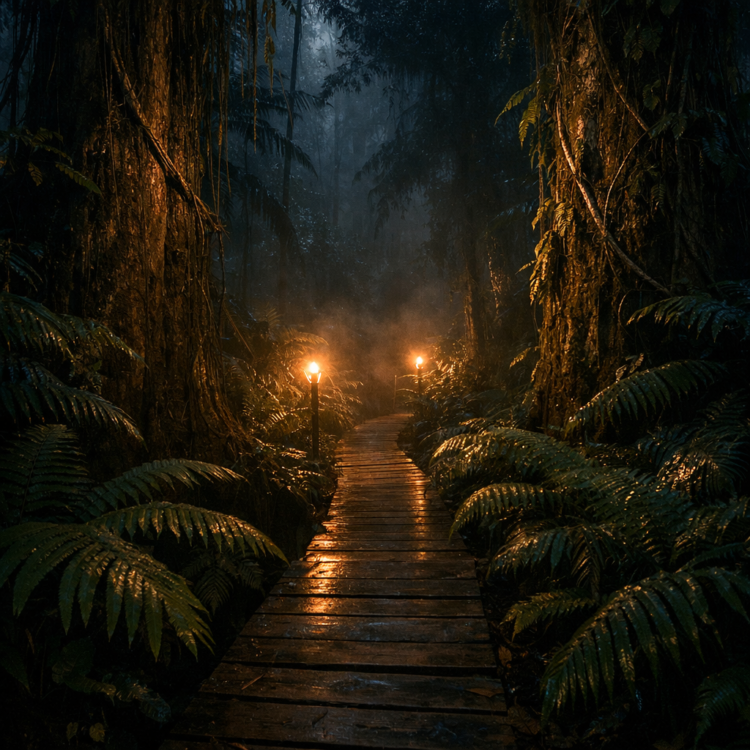
A Daintree rainforest night walk offers something daytime visitors never experience: the forest as it’s been for 135 million years, alive with creatures that only emerge after sunset. While most travellers explore this ancient Queensland rainforest during daylight hours, the real show starts when the sun drops behind the canopy and the nocturnal shift begins.
Why Walk the Daintree Rainforest After Dark?
The Daintree, estimated at around 135 million years old and one of the oldest rainforests in the world, is home to species that have evolved to avoid the heat and predators of daylight. At night, the temperature drops several degrees, humidity hangs thick in the air, and the forest floor comes alive with movement.
You’ll spot tree kangaroos feeding in the canopy—something almost impossible during the day when they’re hidden high in dense foliage. Possums, gliders, and nocturnal birds like the rufous owl become active. The smaller creatures are even more remarkable: luminous fungi glowing pale green on rotting logs, huntsman spiders the size of your hand, stick insects longer than your forearm, and if you’re lucky, the prehistoric-looking Boyd’s forest dragon roosting on low branches.
The soundscape alone makes a nocturnal rainforest walk worthwhile. Daytime bird calls give way to the territorial barks of striped possums, the eerie wails of brush turkeys settling for the night, and the constant background hum of insects you never knew existed.
What to Expect on a Daintree Night Walk Tour
Most guided night walks in the Daintree last between two and three hours. Tours typically start just after sunset, when there’s still enough twilight to adjust your eyes before full darkness settles in. Your guide will provide torches (though bringing your own headlamp is smart), and groups are usually kept small—eight to twelve people—so everyone can hear the guide’s commentary and spot wildlife without crowding.
Expect to walk slowly. Very slowly. This isn’t a fitness hike; it’s a hunt for creatures that freeze when illuminated or scuttle away at the vibration of footsteps. You’ll cover maybe a kilometre over two hours, stopping frequently to examine a spider’s web strung with dewdrops, or to watch a green tree frog the size of a cricket ball sitting motionless on a leaf.
The terrain varies depending on which section of the Daintree you’re exploring, but most established night walk routes follow boardwalks or well-maintained tracks to minimize your impact on the forest floor. Even so, wear closed-toe shoes with grip—timber boardwalks get slippery in the humidity, and you’ll want ankle support if you step off the path to get a better look at something your guide has spotted.
Choosing Your Daintree Nocturnal Tour
Several operators run night walks throughout the Daintree region, from Cape Tribulation down to the Mossman Gorge area. Tour quality varies significantly based on your guide’s knowledge and the route they use. Look for operators who limit group sizes and have guides with genuine expertise in rainforest ecology—someone who can identify animals by their calls and knows where to look for specific species.
Check the official tourism website for the Daintree region for current operators, prices, and booking details. Some tours include pickup from your accommodation; others require you to meet at a specific trailhead. If you’re staying near Cape Tribulation, you’ll have the most options, as this is the heart of the Daintree’s tourist infrastructure.
Private night tours cost more but give you flexibility to linger when you find something interesting, rather than keeping pace with a larger group. Worth considering if you’re a keen photographer or serious about wildlife spotting.
What to Bring on Your Night Walk
Pack light, but pack smart. You’ll be moving slowly, so you won’t overheat, but the humidity means you’ll still work up a light sweat.
- Long, lightweight trousers and a long-sleeved shirt (protects against mosquitoes and brush)
- Insect repellent—apply before you start, not on the trail where it disturbs wildlife
- A headlamp with a red light setting (less disruptive to nocturnal animals than white light)
- Water bottle—you’ll drink less than on a day hike, but the humidity is relentless
- Camera with manual settings if you want wildlife shots (flash is usually discouraged)
- Light rain jacket—even in the dry season, the Daintree can surprise you
Best Time for a Night Walk in the Daintree
The Daintree has two distinct seasons: the wet (roughly December through April) and the dry (May through November). For night walks, the dry season offers more comfortable conditions—less rain, fewer leeches, and cooler temperatures that bring more animals out to feed.
That said, wet season walks have their own appeal. The forest is at its most vibrant, frogs are abundant, and you’re likely to see more amphibians and reptiles. Just be prepared for heavy rain to cut a tour short, and check with operators about cancellation policies during the wet season.
Temperature-wise, winter months (June through August) in far north Queensland are mild, with night temperatures around 17-20°C. Summer nights stay warm and muggy, rarely dropping below 24°C even after midnight.
Why This Beats a Day Walk
Day walks in the Daintree are spectacular—the scale of the trees, the riot of green, the occasional cassowary sighting. But you’re seeing the forest at rest. A Daintree rainforest night walk shows you the forest at work: hunting, feeding, competing for territory, navigating through darkness using senses humans barely possess.
You’ll leave with a different understanding of why this place has survived for 135 million years. It’s not just old. It’s functional in ways that only reveal themselves when we’re not supposed to be watching.
Check with local tour operators or the official Daintree visitor centre for current tour availability and booking details. Most tours run year-round, though frequency increases during peak tourist season from June to October.
You might also like:
- Tamworth Country Pubs: A Perfect Afternoon Between Gallery Visits
- The Best Time to Visit Moree Hot Springs for True Relaxation
For current opening hours, prices and bookings, see Australia.com (Tourism Australia) – Uluru & Kata Tjuta.
