
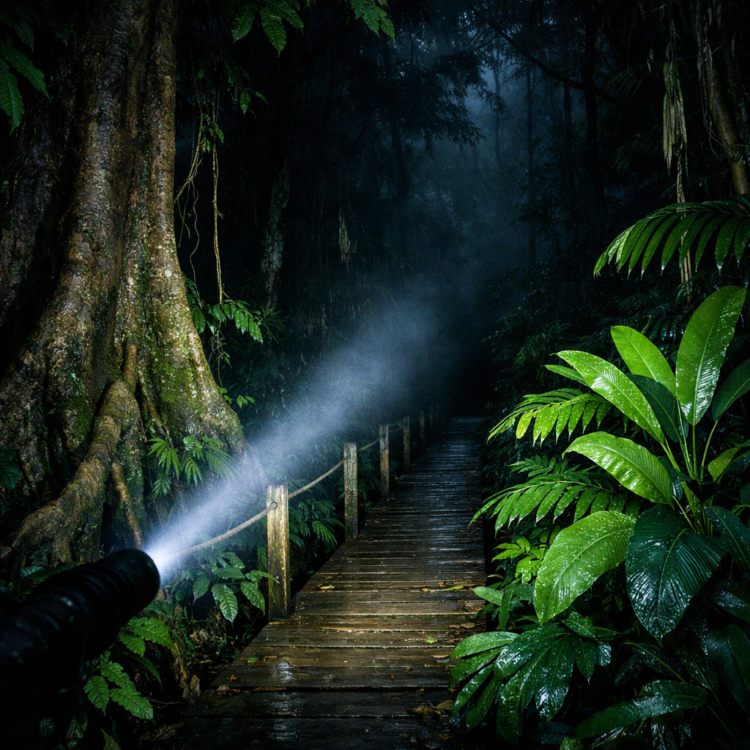
A Daintree Rainforest night walk offers something entirely different from the daytime experience—this 135-million-year-old forest comes alive after sunset with creatures, sounds, and an atmosphere that vanish with the dawn. While most visitors explore during daylight, the real magic happens when your torch beam cuts through the darkness and reveals what’s been hiding all along.
Why Walk the Daintree Rainforest After Dark
The statistics are striking: roughly 60% of tropical rainforest mammals are nocturnal, along with countless insects, frogs, and reptiles. During the day, they’re hidden, sleeping, invisible. At night, they emerge.
The forest floor that seemed quiet at noon suddenly pulses with activity. Tree kangaroos descend from the canopy to feed. Possums rustle through the understory. The giant tree frogs you’d never spot wedged in a tree hollow during daylight now cling to leaves at eye level, their skin glistening in your torchlight. You’re not just visiting the same forest at a different time—you’re stepping into an entirely different world that overlaps geographically but operates on its own schedule.
What to Expect on a Daintree Night Walk
Most Daintree Rainforest night walk experiences happen on boardwalks or well-maintained trails in the region around Cape Tribulation and the Daintree River area in far north Queensland. The darkness is absolute once you’re under the canopy—no streetlights, no ambient glow from nearby towns.
Your guide will move slowly, pausing frequently to shine a light into the canopy or scan the forest floor. The technique is different from daytime wildlife spotting: you’re looking for eyeshine (the reflective glow from nocturnal animals’ eyes), listening for movement in the leaf litter, and watching for silhouettes against the slightly lighter sky visible through gaps in the canopy.
Wildlife You Might Encounter
- Musky rat-kangaroos — tiny marsupials scurrying through fallen leaves (they’re one of the few macropods that are actually diurnal, but easier to approach at night)
- Green tree pythons — coiled on branches at roughly head height, perfectly camouflaged until your torch picks out their distinctive shape
- Boyd’s forest dragons — sleeping on exposed branches, vulnerable in a way they’d never allow during waking hours
- Striped possums — with their skunk-like markings, tearing into rotting wood to extract grubs
- Giant white-tailed rats — despite the name, they’re actually quite endearing, with enormous eyes adapted for night vision
Guided vs Self-Guided Night Walks in the Daintree
You can technically walk Daintree trails at night on your own—nothing physically prevents it. But unless you’re an experienced tropical ecologist, you’ll miss most of what’s around you.
Guides know where certain species tend to hunt or feed. They recognize the subtle movements that signal a python overhead or a cassowary bedded down nearby (yes, cassowaries sleep on the forest floor, and you definitely want to know if one is close). They understand which eyeshine belongs to a harmless possum and which indicates something more cautious, like a spotted-tailed quoll. The difference in what you’ll actually see is dramatic.
Check with the visitor centre or local tour operators for current availability and booking details—some walks run year-round while others operate seasonally depending on weather and trail conditions.
Best Time for a Daintree Rainforest Night Walk
The dry season (roughly June through October, during Australia’s winter months) offers more comfortable conditions—lower humidity, fewer leeches, and less chance of your walk being cancelled due to heavy rain. But the wet season has its own appeal: the frogs are at peak activity, calling from every puddle and branch, and the forest smells rich and alive.
Wildlife activity peaks in the hour or two after sunset, then again in the pre-dawn hours. Most guided nocturnal walks in the Daintree start around 7:30 or 8:00 PM and last between 90 minutes and two hours.
What to Bring on Your Night Walk
A red-light torch is ideal—it’s less disruptive to wildlife and preserves your night vision better than white light. Many tour operators provide these, but bring your own as backup. Closed-toe shoes with good grip are non-negotiable; boardwalks get slippery, and you’re walking in near-total darkness with only a narrow beam of light showing the way.
Light layers work better than a single jacket. You’ll warm up quickly while walking, but standing still during wildlife observations can get cool, especially in the dry season. Insect repellent matters less than you’d think—most Daintree trails at night have fewer mosquitoes than you’d encounter in suburban Brisbane—but bring it anyway for peace of mind.
Long pants help with vegetation brushing against your legs and provide some psychological comfort, even though most of what you’re worried about (snakes, spiders) pose virtually no threat if you stay on the trail and follow your guide’s instructions.
The Soundscape Changes Everything
Here’s something nobody tells you: the sounds matter as much as the sights. The daytime Daintree has bird calls, wind in the canopy, the occasional rustle. At night, the entire frequency range shifts.
Frogs dominate—not just one species calling, but a layered chorus of different pitches and rhythms creating something almost musical. Fruit bats squabble as they feed. Something large crashes through the understory thirty meters away (probably a wild pig, possibly something more interesting). The silence between sounds feels heavier, more expectant than daytime quiet ever does.
You realize quickly that a night walk through the Daintree isn’t about ticking off species on a checklist. It’s about understanding that this ancient rainforest—older than the Amazon—operates on multiple schedules simultaneously, and you’ve been invited, briefly, to experience the shift that’s been happening every sunset for 135 million years.
You might also like:
- Mount Kaputar Hiking Trails: Your Weekend Base in Moree
- A Weekend in Tamworth for Country Music First-Timers (Beyond Festival Season)
For current opening hours, prices and bookings, see Australia.com (Tourism Australia) – Uluru & Kata Tjuta.
