
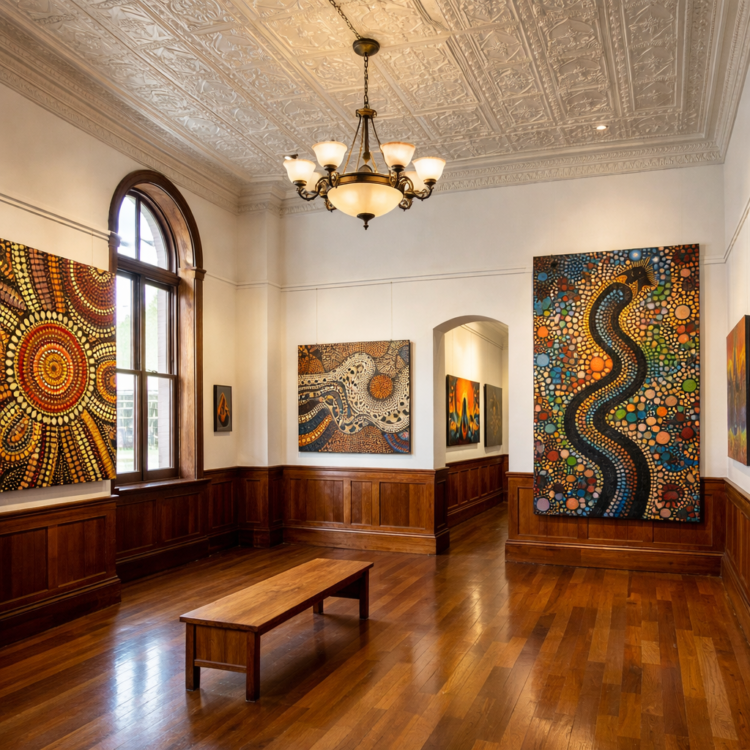
The Aboriginal art collection at BAMM Moree offers something rare in regional Australia: a chance to encounter powerful Indigenous artworks in an intimate, thoughtfully curated space where you can linger as long as you like. Unlike the bustling public galleries of Sydney or Brisbane, this collection lives inside a 1911 heritage bank building in the heart of Moree, where the old vault and timber-lined walls create an unexpectedly perfect backdrop for contemporary and traditional Aboriginal art.
Why the Aboriginal Art Collection at BAMM Moree Stands Out
Bank Art Museum Moree (BAMM) holds one of regional Australia’s most significant Aboriginal art collections, yet many travellers pass through the Gwydir Valley without knowing it exists. That’s precisely what makes it special. Instead of fighting crowds or rushing through room after room, you’ll find yourself standing alone before canvases that demand—and reward—careful attention.
The collection spans diverse styles and stories, from desert dot paintings to contemporary mixed-media works. Because BAMM is a regional gallery, the focus is quality over quantity. Each piece has room to breathe, and you’ll likely have the space to yourself or share it with just a handful of other visitors. For anyone interested in Indigenous art, this is a chance to slow down and truly see the work.
What to Expect Inside the Heritage Bank Building
The museum itself is part of the experience. Housed in a century-old bank on Balo Street, BAMM’s heritage architecture—pressed tin ceilings, polished wood, and the original vault—adds layers of history to your visit. The Aboriginal art collection rotates through the gallery spaces, so exhibitions change periodically. However, the museum’s commitment to showcasing Indigenous voices remains constant.
When you visit, take time to read the artist statements and curatorial notes. Many works connect directly to Gamilaraay Country, the traditional lands on which Moree stands, while others come from desert, coastal, and Torres Strait Island artists. The stories behind the paintings—creation narratives, family histories, connection to land—are as essential as the brushstrokes themselves.
Practical Tips for Visiting the Aboriginal Art at BAMM
Before you go, check with the Moree Visitor Information Centre or BAMM’s official channels for current opening hours and any special exhibitions. Gallery hours can vary seasonally, and it’s worth confirming ahead if you’re planning your day around the visit.
Here’s what to keep in mind:
- Allow at least 45 minutes to an hour to view the Aboriginal art collection properly—rushing defeats the purpose
- Photography policies vary by exhibition; ask staff about current rules when you arrive
- Entry fees (if applicable) and any guided tour options should be confirmed directly with the museum
- The heritage building has character, so accessibility may differ from modern galleries—enquire ahead if you have specific mobility needs
Pairing BAMM with Your Moree Itinerary
BAMM sits on Balo Street among Moree’s Art Deco heritage buildings from the 1920s and 1930s. As a result, you can easily combine your gallery visit with the self-guided Moree Heritage Trail, which covers around 14 sites and maps are available from the Visitor Information Centre. The walking circuit takes you past facades that tell the story of Moree’s interwar prosperity.
Afterwards, the Moree Artesian Aquatic Centre is just a short drive away. There’s something deeply satisfying about moving from quiet contemplation of Indigenous art to floating in 41°C mineral-rich thermal water drawn from the Great Artesian Basin. The contrast—cultural immersion followed by physical relaxation—makes for a memorable day.
Why This Collection Matters Beyond Moree
Regional galleries like BAMM play a crucial role in making Aboriginal art accessible outside capital cities. Moreover, they often present works in ways that prioritise context and storytelling over spectacle. The Aboriginal art at BAMM isn’t just decoration; it’s an invitation to understand Country, culture, and the artists’ lived experiences.
For travellers making the journey to Moree—whether by the daily NSW TrainLink train from Sydney (roughly 8.5 hours), regular flights into Moree Airport, or driving through the cotton and wheat fields of northwest NSW—this collection offers depth you won’t find in tourist brochures. It’s the kind of experience that quietly changes how you see the landscape around you.
Planning Your Visit to Moree’s Indigenous Art Scene
While BAMM is the centrepiece, consider extending your visit to include the Terry Hie Hie Aboriginal Area, about 45 minutes from town, which protects significant Gamilaraay cultural sites. The Yana-y Warruwi walking track there offers another layer of connection to the Indigenous heritage of the region.
Moree sits roughly seven hours from Sydney (around 630km) and 5.5 hours from Brisbane, making it an ideal overnight stop. Several caravan parks with artesian thermal pools—including Gwydir Caravan Park and Moree Tourist Park on the banks of the Mehi River—let you base yourself comfortably while exploring the town’s cultural offerings. Check with the Moree Visitor Information Centre for current accommodation details and to collect your Heritage Trail map before heading to BAMM.
You might also like:
- How to Write a Tutoring Ad That Attracts the Right Students
- Winter Soaking: Why June to August is the Best Time to Visit Moree Artesian Spa
For current opening hours, prices and bookings, see NSW National Parks – Mount Kaputar National Park.
