
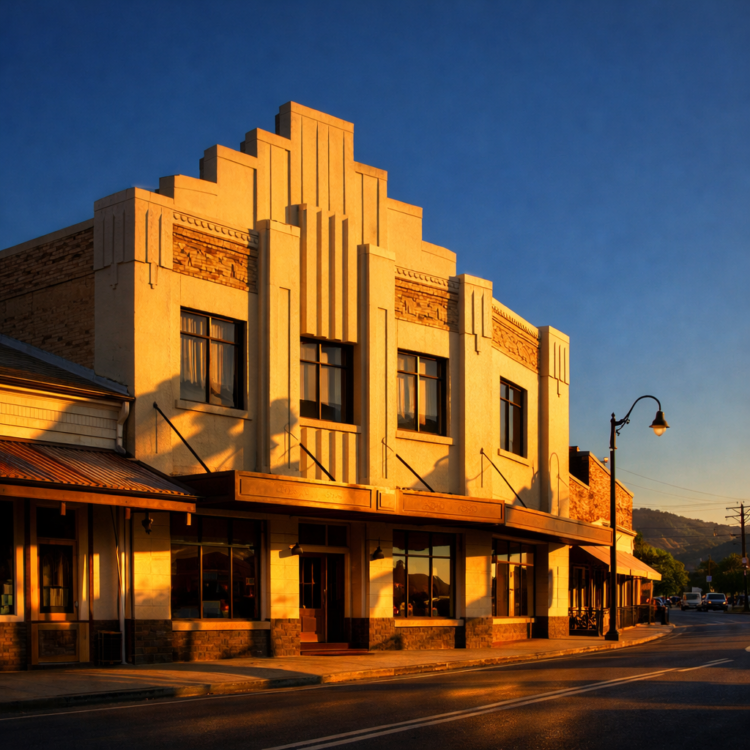
The Moree Art Deco architecture along Balo Street becomes pure magic in the hour before sunset, when warm light rakes across geometric facades and casts shadows that reveal every decorative detail. If you’re planning to explore the town’s heritage trail with a camera in hand, timing and positioning make all the difference between snapshots and truly memorable images.
Why Moree Art Deco Architecture Photographs So Beautifully
Built during the 1920s and 1930s, Moree’s Art Deco buildings feature the bold geometric patterns, stepped parapets, and decorative brickwork characteristic of the era. However, what makes these structures particularly photogenic is their orientation along Balo Street. Most facades face east or west, meaning early morning and late afternoon light strikes them at dramatic angles rather than flattening them with overhead midday sun.
The relatively low-rise streetscape also means you won’t struggle with towering modern buildings blocking your light or cluttering your composition. For example, the clean lines and intact heritage details create frames that look like they’ve stepped straight out of the interwar period.
Best Times to Photograph Balo Street’s Heritage Buildings
Golden hour—the period roughly 45 minutes before sunset—delivers the warmest, most flattering light for architectural photography. In Moree, this means planning your self-guided heritage walk for late afternoon. The low-angled sunlight enhances the texture of rendered walls, highlights decorative reliefs, and creates long shadows that add depth to geometric patterns.
Early morning, about 30-60 minutes after sunrise, offers similarly beautiful light with an added bonus: Balo Street is quieter, giving you clearer shots without parked cars or foot traffic. Meanwhile, overcast days shouldn’t disappoint you. Soft, diffused light eliminates harsh shadows and works beautifully for capturing pastel colour schemes and subtle architectural details.
Seasonal Considerations
Northwest NSW summers bring golden hour later in the evening (around 6-7pm), while winter pushes it earlier (around 4-5pm). Check current sunset times before your visit and plan accordingly, allowing at least 90 minutes to walk the heritage trail at a photographer’s pace.
Essential Gear and Settings for Art Deco Photography
You don’t need professional equipment to capture Moree’s Art Deco heritage beautifully, but a few considerations will improve your results significantly. A smartphone camera works perfectly well, especially newer models with wide-angle capabilities. If you’re bringing a dedicated camera, a wide-angle lens (24-35mm equivalent) lets you capture entire facades from street level, while a 50mm lens isolates decorative details.
Here’s what to pack for your architectural photography walk:
- Camera or smartphone with adequate battery life (allow for 100+ shots)
- Wide-angle lens or wide-angle smartphone mode for full-building compositions
- Polarizing filter to reduce glare from windows and deepen sky blues (optional but helpful)
- Notebook or phone app to record building names and locations for captions
- Hat and water—you’ll be walking in open sun between sites
As a result of Balo Street’s relatively narrow width, you’ll often shoot from the opposite footpath to capture full facades. Keep your ISO low (100-400) in good light to minimize noise, and use a slightly narrower aperture (f/8-f/11) to keep the entire building in sharp focus.
Composition Techniques for Moree’s Heritage Trail
Art Deco architecture rewards careful framing. Look for strong vertical and horizontal lines, then align them with your frame edges to create balanced, pleasing compositions. Many of Moree’s heritage buildings feature symmetrical facades—position yourself directly centre to emphasize this symmetry, or deliberately offset your angle to create dynamic tension.
Moreover, don’t overlook the details. Step closer to capture zigzag motifs, stylized floral patterns, decorative cornices, and original signage. These close-up shots add variety to your collection and highlight the craftsmanship of the era. Furthermore, including context—a section of street, neighbouring buildings, or the wide northwest NSW sky—tells a richer story than isolated facades alone.
Navigating the Self-Guided Heritage Trail with Photography in Mind
The Moree Heritage Trail map, available from the Visitor Information Centre, marks approximately 14 Art Deco and heritage sites around town. Pick up this map before you start—it identifies each building and provides historical context that enriches your photographic project. The trail is easily walkable, with most sites concentrated along Balo Street and surrounding blocks.
Plan to spend 90 minutes to two hours if you’re shooting thoughtfully. Start at the western end of Balo Street during late afternoon, so you’re moving with the light as it shifts. Alternatively, if you’re shooting in the morning, reverse your route. Check with the Visitor Information Centre for any current access restrictions or building works that might affect your photography.
Combining Architecture with Other Moree Attractions
After your architectural walk, consider visiting the Bank Art Museum Moree (BAMM), housed in a 1911 heritage building. While not Art Deco itself, the building offers another photogenic facade, and the museum’s collection provides indoor interest if the afternoon heat becomes too intense. Alternatively, reward yourself with a soak at the Moree Artesian Aquatic Centre—those thermal pools feel particularly wonderful after a few hours on foot with camera in hand.
Sharing and Preserving Your Moree Art Deco Images
Your photographs do more than capture personal memories—they help document and celebrate Moree’s architectural heritage. Consider sharing your best images on social media, tagging the location to help other architecture and heritage enthusiasts discover these gems. However, always photograph respectfully, avoiding intrusive angles into private spaces or commercial interiors without permission.
The combination of accessible heritage sites, photogenic golden-hour light, and well-preserved 1930s facades makes Moree a surprisingly rewarding destination for architectural photography. Whether you’re a serious photographer or simply someone who appreciates beautiful buildings, the Art Deco architecture of Balo Street offers a visual journey back to the optimism and style of interwar Australia—one frame at a time.
You might also like:
- Winter in Moree: Why Cold Nights Make the Artesian Spa Truly Magical
- Moree Hot Springs Caravan Parks: Soaking Under the Stars
For current opening hours, prices and bookings, see Visit NSW – Moree.

Bondi to Coogee Walk at Sunrise: Why Dawn is the Best Time to Experience Sydney's Coastal Trail | ClassifiedZ
September 15, 2026 at 2:08 am
[…] Moree Art Deco Architecture: How to Photograph Balo Street’s Golden Hour Facades […]